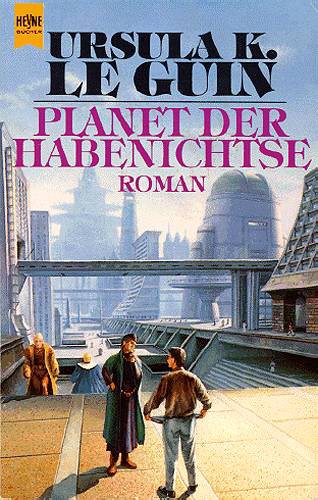
The cover blurb for The Dispossessed makes it sound like a thrilling exciting narrative, filled with tension and action:
Shevek, a brilliant physicist, decides to take action. He will seek answers, question the unquestionable, and attempt to tear down the walls of hatred that have isolated his planet of anarchists from the rest of the civilized universe. To do this dangerous task will mean giving up his family and possibly his life—Shevek must make the unprecedented journey to the utopian mother planet, Urras, to challenge the complex structures of life and living, and ignite the fires of change.
But that's not what it is, and it's certainly not Le Guin's focus. This is clear in the way she avoids what might be the more dramatic elements of the story, or distances us from them in how they are portrayed. The story is bookended by two examples of that. The opening sees Shevek - although we don't know it's him at this stage - leaving his homeworld and causing quite a bit of upset, seen from the viewpoint of a minor character who never reappears. And the book ends abruptly with no certainty of an outcome.
The capitalist society on the planet Urras that Shevek travels to felt too much like 1950s America rather than some far flung society thousands of years in the future. Other elements of the novel such as Shevek's unfortunate sexual dalliance, the possibility of defecting from the capitalist society to a nearby communist society, and getting caught up in a riot really don't amount to much and the plot as a whole is quite thin.
What I did like about the book was Le Guin's vivid portrayal of a functioning anarchist society on Shevek's homeworld Anarres. And Shevek himself was a likeable character.
The book is more concerned with the question of whether a truly anarchist society can survive, given the generally acquisitive nature of humanity, and during the story there is an indication that even this utopia will fall foul of the general tendency for all systems of government to move towards a hierarchy of control.
Shevek struggles against this tendency:
"We’ve been saying, more and more often, you must work with the others, you must accept the rule of the majority. But any rule is tyranny. The duty of the individual is to accept no rule, to be the initiator of his own acts, to be responsible. Only if he does so will the society live, and change, and adapt, and survive."
We never know if Shevek achieves what the cover blurb says. There's not much indication that the capitalist society will change because of him, though the anarchist society may survive if they take the example of his life to heart. But with no certainty about how the story ends, all we are left with is a political thought experiment.