None
5 stars
A lot of interesting things about language, translation and empire wrapped up in an adventure through an alternative 19th Century England
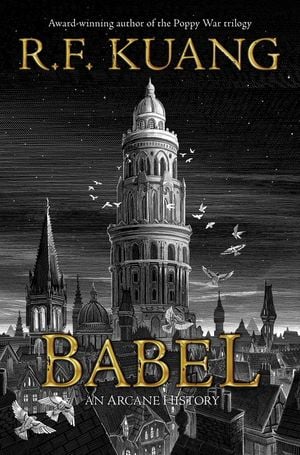
Hardcover, 544 pages
English language
Published Aug. 22, 2022 by Harper Voyager.
Traduttore, traditore: An act of translation is always an act of betrayal.
For Robin, Oxford is a utopia dedicated to the pursuit of knowledge. But knowledge obeys power, and as a Chinese boy raised in Britain, Robin realizes serving Babel means betraying his motherland. As his studies progress, Robin finds himself caught between Babel and the shadowy Hermes Society, an …
Traduttore, traditore: An act of translation is always an act of betrayal.
For Robin, Oxford is a utopia dedicated to the pursuit of knowledge. But knowledge obeys power, and as a Chinese boy raised in Britain, Robin realizes serving Babel means betraying his motherland. As his studies progress, Robin finds himself caught between Babel and the shadowy Hermes Society, an organization dedicated to stopping imperial expansion. When Britain pursues an unjust war with China over silver and opium, Robin must decide . . .
Can powerful institutions be changed from within, or does revolution always require violence?
A lot of interesting things about language, translation and empire wrapped up in an adventure through an alternative 19th Century England
Babel kommt mit einer spannenden Prämisse. Das Buch spielt in England des 19. Jahrhunderts einer alternativen Zeit und eine der stärksten Treiber für Innovationen sind "magische" Silberbarren. So fand man heraus, dass über Linguistik und Gravuren von verwandten Wörtern in unterschiedlichen Sprachen die Barren die Realität verändern können.
Das Buch folgt Robin Swift, einem chinesischen Jungen, der von Professor Lovell mit nach England genommen wird, nachdem seine Familie an Cholera starb und fast er selbst auch. Die Geschichte verfolgt seine Vorbereitung auf Oxford, das Zentrum des Wissens und Heimat des königlichen Instituts der Übersetzungen.
Robin lernt Freunde kennen, aber auch immer weiter die Zahnräder der Welt wie z.B. die Auswirkungen des Kolonialismus und Kapitalismus.
Besonders gefallen hat mir der Schreibstil. Er erzählt die Geschichte spannend, aber vermittelte mir auch leicht den akademischen Charakter. So gibt es kurze Erklärungen zu Wortpaaren, Fußnoten und Echtwelt-Einspielungen. Durch die Augen von Robin lernen wir …
Babel kommt mit einer spannenden Prämisse. Das Buch spielt in England des 19. Jahrhunderts einer alternativen Zeit und eine der stärksten Treiber für Innovationen sind "magische" Silberbarren. So fand man heraus, dass über Linguistik und Gravuren von verwandten Wörtern in unterschiedlichen Sprachen die Barren die Realität verändern können.
Das Buch folgt Robin Swift, einem chinesischen Jungen, der von Professor Lovell mit nach England genommen wird, nachdem seine Familie an Cholera starb und fast er selbst auch. Die Geschichte verfolgt seine Vorbereitung auf Oxford, das Zentrum des Wissens und Heimat des königlichen Instituts der Übersetzungen.
Robin lernt Freunde kennen, aber auch immer weiter die Zahnräder der Welt wie z.B. die Auswirkungen des Kolonialismus und Kapitalismus.
Besonders gefallen hat mir der Schreibstil. Er erzählt die Geschichte spannend, aber vermittelte mir auch leicht den akademischen Charakter. So gibt es kurze Erklärungen zu Wortpaaren, Fußnoten und Echtwelt-Einspielungen. Durch die Augen von Robin lernen wir die Vorzüge und gleichzeitig den Horror von Wohlstand des 19. Jahrhunderts kennen. Ich denke, die Aussage von Rebecca Roanhorse "A Masterpiece" ist nicht unbedingt übertrieben.
Ich hab noch Yellowface auf meiner Leseliste, aber bin nun auch gespannt auf weitere Romane der Autorin. :-)
Kuang's story surprises. This coming-of-age (and coming-of-revolution) story introduces us to a world where the the 19th-century Industrial Revolution is made possible not by steam and worker oppression but by the magical powers of translation and colonial exploitation. The experiences of the protagonist, a Cantonese boy that adopts the English name Robin Swift, lead us to an imagined Oxford that is as intriguing as Hogwarts but that has sins that Kuang not only does not whitewash, but makes the centerpiece of her novel. The historical notes and especially the etymological explanations are fascinating, if occasionally pedantic. Once you get your head around this world and how it works, you'll want to hang on to the end to see how a postcolonial critique during the height of the British Empire can possibly turn out.
This memorable novel is both ingeniously creative and importantly timely in its message. R.F. Kuang weaves together a story that injects magical realism into a novel that is both historical and revisionist. That is, this is a story that asks us to imagine the road not taken at a certain time in history, and the ethics of the decisions of those in power–and question how and why such power came to be, in the first place.
I felt that the characters were well-developed and realistically complex, making it possible for the reader to feel the emotion in their stories. The plot was also well crafted and paced.
Instead of summarizing the plot, I want to simply recommend this novel, which I knew nothing about before I started reading. Part of the magic, for me, was simply reading on to discover the shape of the world as it is created by …
This memorable novel is both ingeniously creative and importantly timely in its message. R.F. Kuang weaves together a story that injects magical realism into a novel that is both historical and revisionist. That is, this is a story that asks us to imagine the road not taken at a certain time in history, and the ethics of the decisions of those in power–and question how and why such power came to be, in the first place.
I felt that the characters were well-developed and realistically complex, making it possible for the reader to feel the emotion in their stories. The plot was also well crafted and paced.
Instead of summarizing the plot, I want to simply recommend this novel, which I knew nothing about before I started reading. Part of the magic, for me, was simply reading on to discover the shape of the world as it is created by this author.
Bravo!
It was good, really good. The characters were interesting and three dimensional and enjoyable, the setting and plot was engaging and high stakes, and the translation lectures were tailor made for language nerds like me.
However, don’t do like I did and go into this expecting a fantasy novel. This is, mostly, historical fiction with a magic system reskinning technological progress in Victorian England.
This is not a knock on it, though, saying that it’s superfluous; it has a very interesting, if specific effect on the reader’s relationship with the world. It moves all of the varied goods and services that imperial Britain used to maintain power over their colonies into one spot and one profession: Oxford translators. As I see it, the silver magic system mostly exists to move the political center of Britain into this area. And I enjoyed it if only for this facet, if not for …
It was good, really good. The characters were interesting and three dimensional and enjoyable, the setting and plot was engaging and high stakes, and the translation lectures were tailor made for language nerds like me.
However, don’t do like I did and go into this expecting a fantasy novel. This is, mostly, historical fiction with a magic system reskinning technological progress in Victorian England.
This is not a knock on it, though, saying that it’s superfluous; it has a very interesting, if specific effect on the reader’s relationship with the world. It moves all of the varied goods and services that imperial Britain used to maintain power over their colonies into one spot and one profession: Oxford translators. As I see it, the silver magic system mostly exists to move the political center of Britain into this area. And I enjoyed it if only for this facet, if not for all the other symbolism it brings to the table.
However, I think it’s easy to be misled as a reader, that you will be seeing imaginative “what if?”s that are the bread and butter of alternate history fantasy novels.
To sum up, I recommend giving this novel a try if you are at all interested in Victorian England, in translation/linguistics, or just enjoy a really good, tragic, character driven story.
Like #TedChiang's ‘Seventy Two Letters’, Babel is set in a fantastical alternative history of England during the Industrial Revolution. In Kuang's universe, the revolutionary tech is yínfúlù, silver talismans engraved with a word in one language and it's translation in another. When a bilingual utters the words, the subtle differences between their meanings are released by the silver, working magic on the physical world. “The power of the bar lies in words. More specifically, the stuff of language the words are incapable of expressing - the stuff that gets lost when we move between one language and another. The silver catches what's lost and manifests it into being.” Like in #UrsulaLeGuin's Earthsea, words have magical power, but also like Earthsea, the magic is taught to adepts in cloistered academies, in Kuang's case the Royal Institute of Translation. Translators are not only key to great leaps in productivity for British Industry, …
Like #TedChiang's ‘Seventy Two Letters’, Babel is set in a fantastical alternative history of England during the Industrial Revolution. In Kuang's universe, the revolutionary tech is yínfúlù, silver talismans engraved with a word in one language and it's translation in another. When a bilingual utters the words, the subtle differences between their meanings are released by the silver, working magic on the physical world. “The power of the bar lies in words. More specifically, the stuff of language the words are incapable of expressing - the stuff that gets lost when we move between one language and another. The silver catches what's lost and manifests it into being.” Like in #UrsulaLeGuin's Earthsea, words have magical power, but also like Earthsea, the magic is taught to adepts in cloistered academies, in Kuang's case the Royal Institute of Translation. Translators are not only key to great leaps in productivity for British Industry, but also at the nexus of Britain's project for empire and colonisation. The empire's next target is China, and the novel opens with a boy, the only survivor of Asiatic Cholera in his Canton household, is rescued and cured with silver-work by a mysterious Englishman, Professor Lovell. The professor spirits the boy off to London, forcing him to choose an English name (Robin) and abandon his native Cantonese in favour of the more ‘useful’ Mandarin tongue. Like #PhilipPullman's The Golden Compass, the hero is a youth of ambiguous parentage, growing up in an Oxford college, mentored by a distant, dismissive father figure. He's brought up studying Latin and Greek, and afforded a ‘opportunity’ to enter the Royal Institute of Translation, with a small cohort of foreign-born multilinguals. Like the Le Guin's academy, the he finally finds recognition and love amongst his peers, and a long lost sense of belonging, a salve for his lifelong alienation. Robin loves student life, but glossing over the underlying racism of Britain in general and Oxford in particular, and ignoring the growing realisation that silver-work is a tool for oppression in the colonies and a weapon of imperial expansion, become increasingly unsustainable. He realises the ‘opportunity’ is slavery wrapped in a false promise. The novel's civilised beginnings are misleading. The tension, violence, and stakes rise inexorably amongst revelations about his origins, shadowy resistance groups, betrayal, excruciating torture, and sudden death. Ostensibly about English colonial hegemony in centuries past, the novel has a lot to say about Silicon Valley's global imperial projects of similar magnitude, digital and linguistic sovereignty violated by today's magic: machine learning in general, and natural language processing in particular. Kuang's 'Babel' is action packed, and also bristling with etymological curiosities and translation theory. I loved it not only because of its germane themes and because I'm a nerd linguist, but also because it was a great, heartrending adventure, with a great deal of resonance not only presumably for colonised people and immigrants everywhere, but anyone who's spent time bathed in alienation or crises of identity.